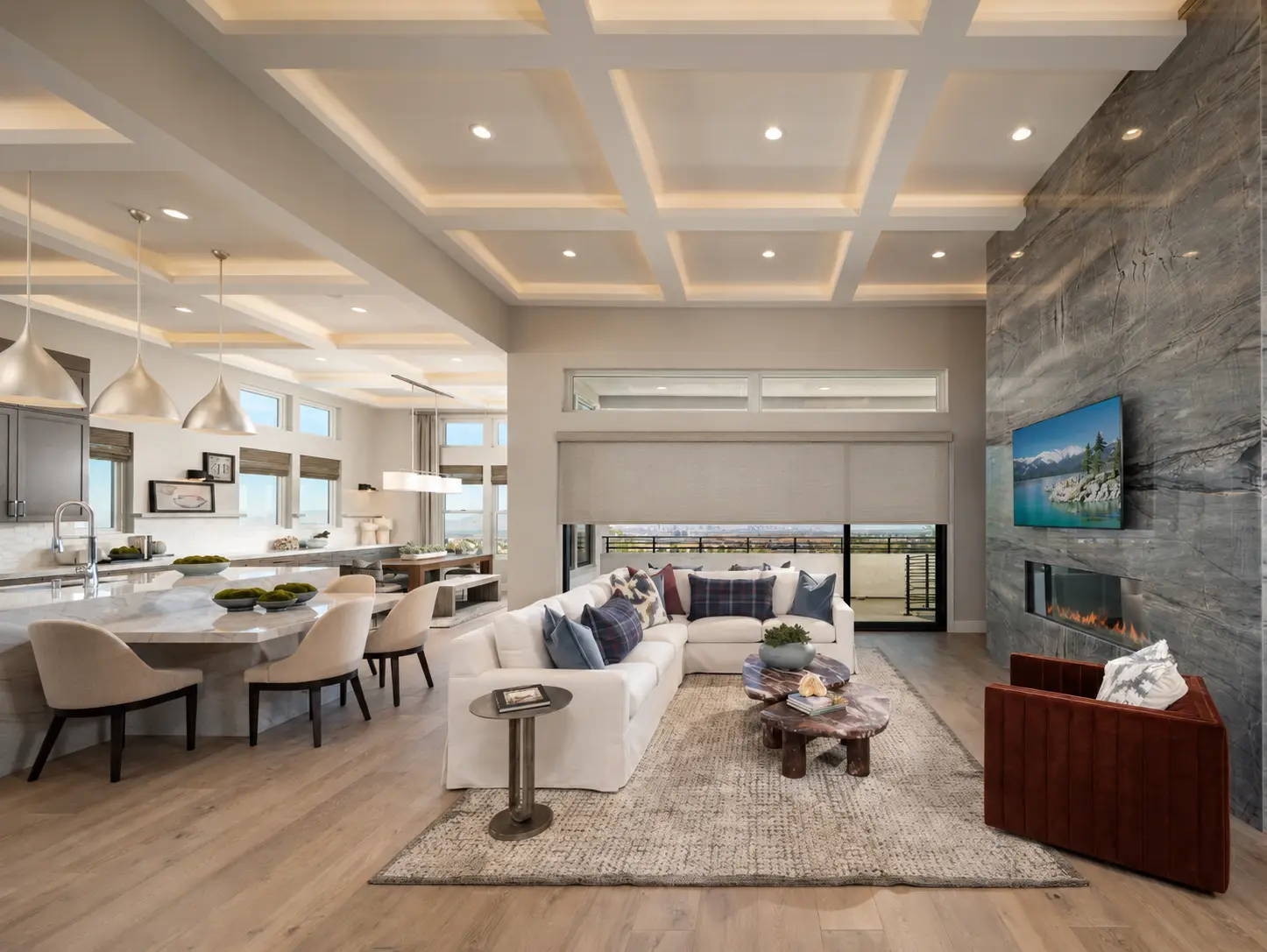
Tall and hard-to-reach windows are where motorization can create some of its clearest daily value. One control can operate glass above a staircase, in a two-story great room, or behind furniture that makes a manual shade impractical. The same height that makes the motor useful also makes charging, cleaning, troubleshooting, and future replacement harder.
That is why a high-window plan should be evaluated as a long-term access system, not only as a motorized product. The shade, power source, controls, mounting, and service route need to work together.
Choose power around access, not convenience on installation day
Rechargeable motors can simplify installation in a finished home, but every rechargeable system eventually needs a charging method. Before ordering, locate the connection and demonstrate how it will be reached. A compatible extension or charging wand may help on some systems; it should be confirmed for the exact motor rather than assumed.

Hardwired power can remove routine charging from the ownership experience and may be the stronger choice during new construction or a major remodel. It still requires planning for wire locations, power supplies, access panels, shade pockets, and future motor service. Plug-in power works only when the outlet and cord path are safe, concealed, and serviceable.
Motor capacity must match the finished shade
High windows are often large windows. Width, height, tube selection, fabric weight, top treatment, and installation conditions determine which motor and shade construction are appropriate. The fact that a motor fits inside a product line does not mean it is the right motor for every size in that line.
Ask how the selected system handles limits, obstacle conditions, and grouped operation. Exact capabilities vary, and no shade should be forced if movement changes.
Set realistic expectations for grouped movement
Multiple tall shades can be programmed to start together, but their edges may not remain perfectly aligned at every instant. Motor type, shade size, fabric, power condition, and calibration can affect timing. Judge the finished appearance when the shades reach their intended positions and discuss how the selected platform synchronizes groups.
Plan cleaning and inspection without routine climbing
High shade fabric usually needs gentle, product-approved dust removal rather than aggressive cleaning. Consider how a qualified cleaner or service technician will reach the treatment and protect nearby floors, stairs, art, and furnishings. If special access equipment will be required, knowing that before purchase helps prevent surprises.
Keep a service route and product record
Document the motor family, power supply, controls, programming, fabric, installation date, and warranty. Photograph concealed power supplies and access points before construction finishes cover the surrounding area. Confirm whether the shade can be removed from the room side and whether adjacent trim or a pocket closure needs to be opened.
High-window planning checklist
- Confirm the exact shade size and motor capacity
- Identify the charging connection or hardwired service point
- Demonstrate how routine charging will happen without unsafe ladder dependence
- Coordinate wire, pocket, outlet, and access-panel locations before finishes
- Confirm how the shade and motor can be removed for future service
- Plan product-approved cleaning and professional access where needed
- Test individual and grouped controls from the floor
- Keep the complete product and power schedule with the home records