 Las Vegas Motorized Shades
Motorized shutters
Automated louver control for a product built into the room.
A specialized direction for homeowners who want the architectural presence of plantation shutters with powered tilt considered for privacy, light, or hard-to-reach applications.
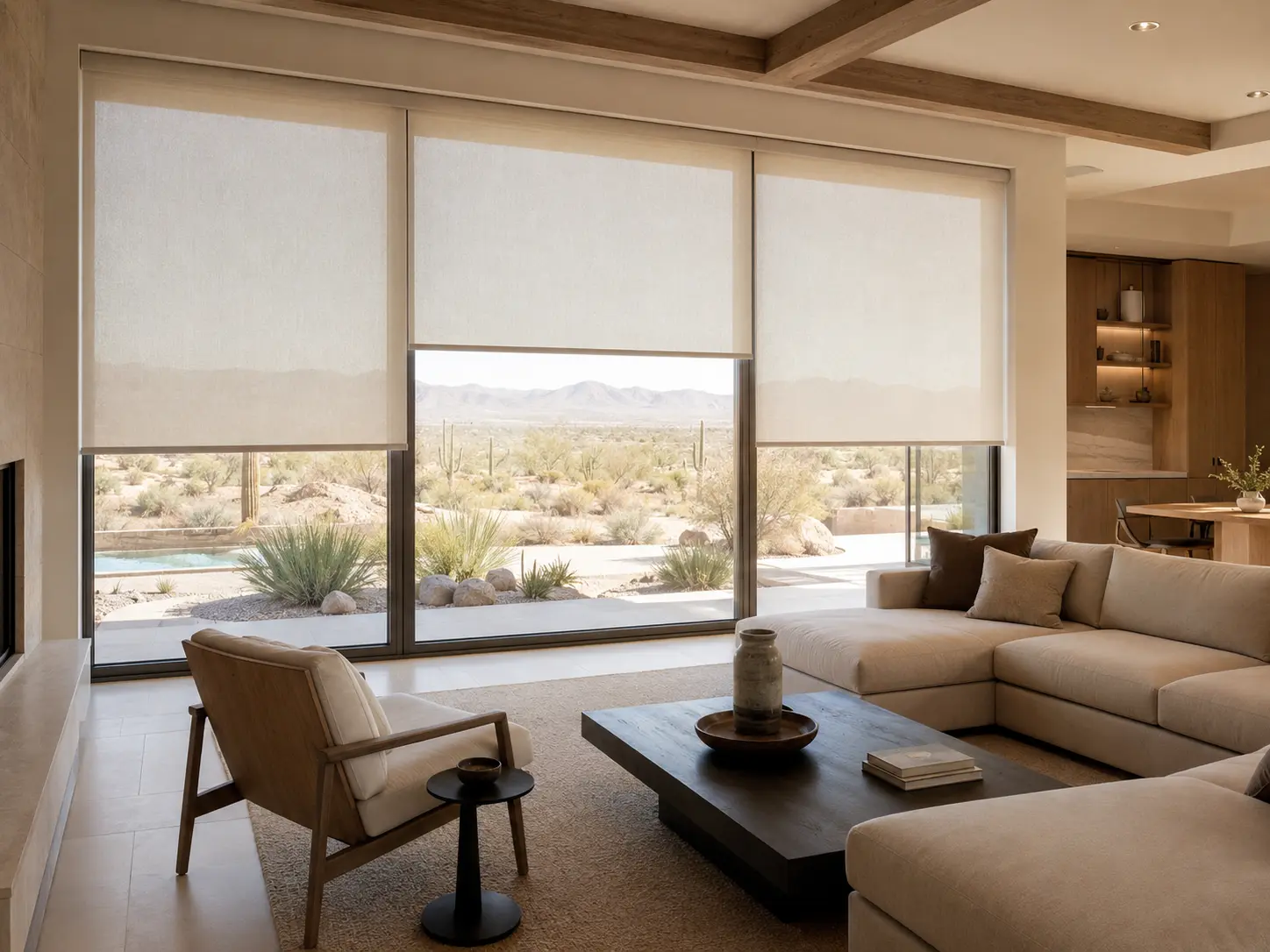 Preliminary inspiration · final product confirmed in your home
Our point of view
Motorized Shutters should solve the room—not merely add a motor.
Motorized shutters are not simply roller shades with a different surface. In many configurations, motorization concerns louver tilt rather than opening and closing entire shutter panels. Product availability, panel access, wiring, controls, and serviceability must be confirmed for the exact application.
Why consider shutters
What this direction can bring to the home.
Architectural permanence
Shutters become part of the window composition and can create a substantial finished appearance.
Powered light control
Automated tilt may help manage privacy and light where manual louver operation is inconvenient.
Special-window potential
Hard-to-reach or repeated shutter sections may justify a powered direction when a compatible system exists.
Coordinated scenes
Some systems may participate in broader control routines, subject to exact compatibility confirmation.
Understand the movement
Tilt is different from opening panels.
A powered system may rotate louvers while the shutter panels still require manual access. The intended daily behavior should be clear before choosing the product.
Built around the window
Panel layout and access still lead the design.
Frames, panels, divider rails, obstructions, doors, and window access affect whether a shutter is appropriate—with or without motorization.
Specialized ownership
Serviceability belongs in the first conversation.
Motor location, power, access, controls, warranty, and long-term service vary. Your designer should document the ownership path for the exact system.
Room-by-room thinking
Where shutters may make the most sense.
These are starting points. Window conditions, fabric, exposure, power, and daily use still determine the final direction.
High windows
Consider powered tilt where manual louver access is difficult.
Privacy-sensitive rooms
Adjust louvers while keeping the architectural shutter look.
Repeated window banks
Explore coordinated tilt across multiple sections.
Design-led spaces
Use shutters when built-in visual weight is part of the goal.
Before you choose
Design the ownership experience too.
Ask how the shades are powered, controlled, recharged or serviced; what happens if a motor or control stops responding; and who supports the system after installation. Exact answers belong to the selected product—not a generic promise.
Explore easy-recharging considerations →A useful comparison
Need full shade movement instead?
Roller shades may be the more direct answer when the goal is raising, lowering, blackout, solar performance, or broad glass coverage.
Compare roller shades →Straight answers
Questions about shutters.
Do motorized shutters open the panels automatically?
Not necessarily. Many powered shutter concepts focus on louver tilt. The exact movement depends on the product and must be confirmed.
Can motorized shutters connect to a smart home?
Compatibility varies by motor, controller, interface, and home system. It should never be promised without confirming the exact components.
Are motorized shutters right for every room?
No. Their architectural presence and specialized ownership make them a considered option, not a universal motorized solution.
See the difference at your windows
Compare real materials, controls, and movement in your home.
Your designer brings relevant samples, reviews the rooms, confirms the technical details, and provides the exact plan and price.