 Las Vegas Motorized Shades
Motorized natural & woven shades
Organic texture, tailored for easier everyday use.
Woven woods, reeds, grasses, and related natural materials bring warmth and variation to the window, with motorization considered where lifting larger treatments or coordinating a room adds real value.
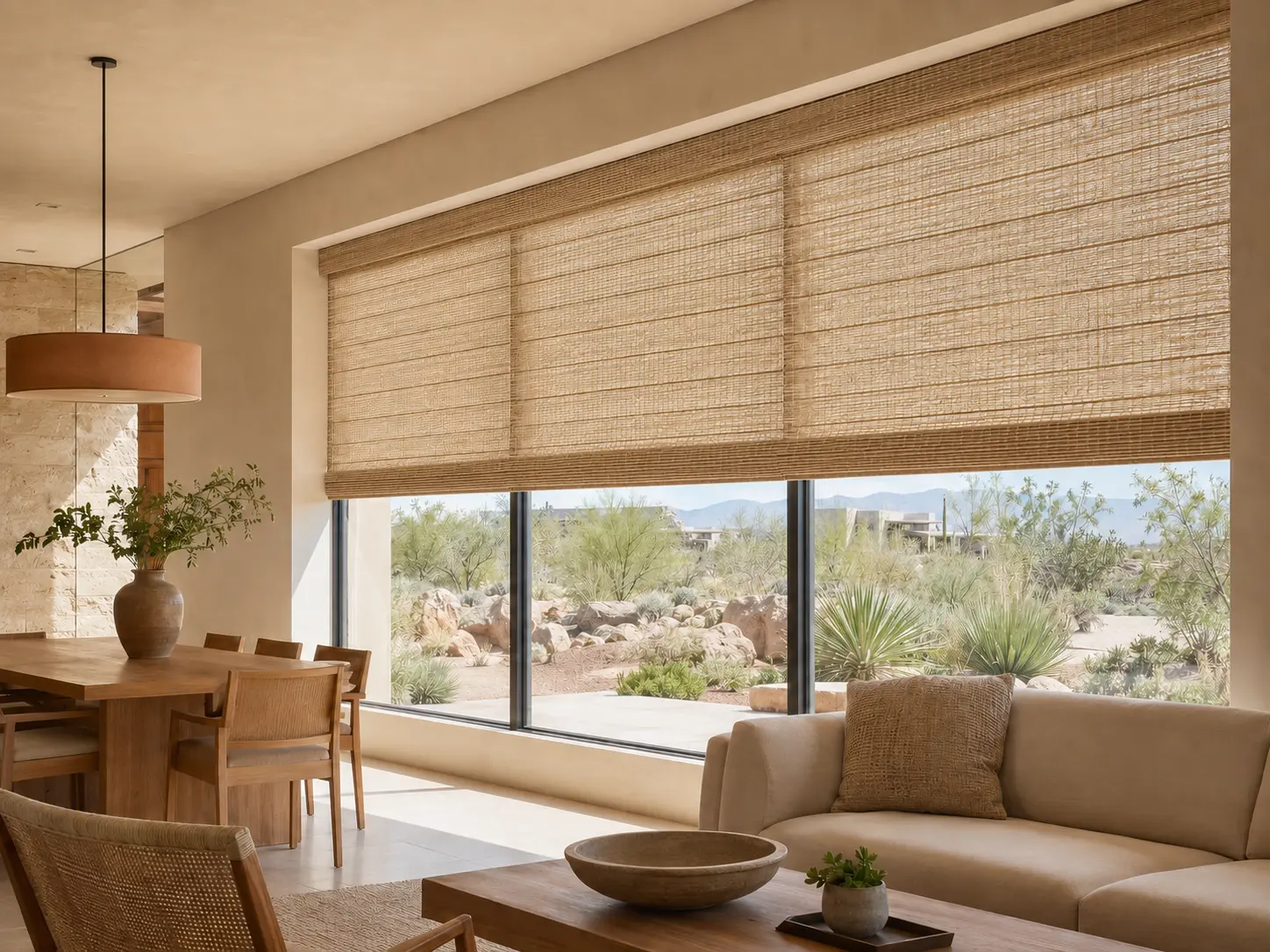 Preliminary inspiration · final product confirmed in your home
Our point of view
Motorized Natural & Woven Shades should solve the room—not merely add a motor.
Natural woven shades are not meant to look perfectly uniform. Their appeal comes from visible fiber, tonal shifts, slubs, and the way daylight reveals the weave. Motorization can simplify operation, but the best design begins with material character, liner choice, fold behavior, and how much privacy or light control the room actually needs.
Why consider natural woven shades
What this direction can bring to the home.
Material with character
Wood, bamboo, grasses, reeds, and woven fibers add depth that a smooth performance fabric intentionally avoids.
Warmth without heavy layers
A woven shade can soften modern architecture while preserving a relatively tailored window silhouette.
Flexible lining
Unlined, light-filtering, privacy, and room-darkening directions can change the experience significantly, subject to the selected collection.
Easier daily lifting
Motorization may be valuable on larger woven treatments or in rooms where repeated manual operation would be inconvenient.
Expect variation
The irregularities are part of the design.
Natural fibers can vary in color, thickness, spacing, and response to light. Samples help establish the overall direction, but they are not a promise that every finished section will be identical.
The liner changes the room
Texture and performance must be designed together.
An open weave may glow beautifully but provide limited privacy. A liner can add privacy or room darkening while changing the shade's appearance from inside and outside. Your designer compares those tradeoffs in the room.
Movement and care
A beautiful material still needs a practical ownership plan.
Fabrication style, size, motor availability, charging access, dust, pets, and approved cleaning methods all matter. Wet cleaning is generally not something to assume with natural materials.
Room-by-room thinking
Where natural woven shades may make the most sense.
These are starting points. Window conditions, fabric, exposure, power, and daily use still determine the final direction.
Dining rooms
Add warmth and visible craft to a room made for gathering.
Primary bedrooms
Combine soft texture with a carefully selected privacy or room-darkening liner.
Home offices
Make a functional workspace feel more residential and considered.
Great rooms
Introduce organic material where broad architecture needs softness.
Before you choose
Design the ownership experience too.
Ask how the shades are powered, controlled, recharged or serviced; what happens if a motor or control stops responding; and who supports the system after installation. Exact answers belong to the selected product—not a generic promise.
Explore easy-recharging considerations →A useful comparison
Prefer a more precise, graphic way to filter light?
Sheer and zebra shades create cleaner band or vane alignment, while woven shades celebrate natural irregularity and texture.
Compare sheer and zebra shades →Straight answers
Questions about natural woven shades.
Are woven shades made from natural materials?
Many collections use woods, bamboo, grasses, reeds, or blends that emphasize natural texture. Exact fiber content varies and should be confirmed from the selected sample.
Can woven shades be room darkening?
Compatible liners can substantially reduce light, but the weave, mounting gaps, seams, and window conditions affect the result. Room darkening is not the same as a guaranteed blackout room.
Can every woven shade be motorized?
No. Motorization depends on the fabrication style, size, material weight, liner, and available system. Your designer confirms the exact combination.
See the difference at your windows
Compare real materials, controls, and movement in your home.
Your designer brings relevant samples, reviews the rooms, confirms the technical details, and provides the exact plan and price.