 Las Vegas Motorized Shades
Motorized sheer & zebra shades
Shape the daylight without giving up visual interest.
Alternating sheer and fabric bands—or soft vanes suspended between sheer layers—create a more dimensional way to balance filtered light, privacy, and view-through at the window.
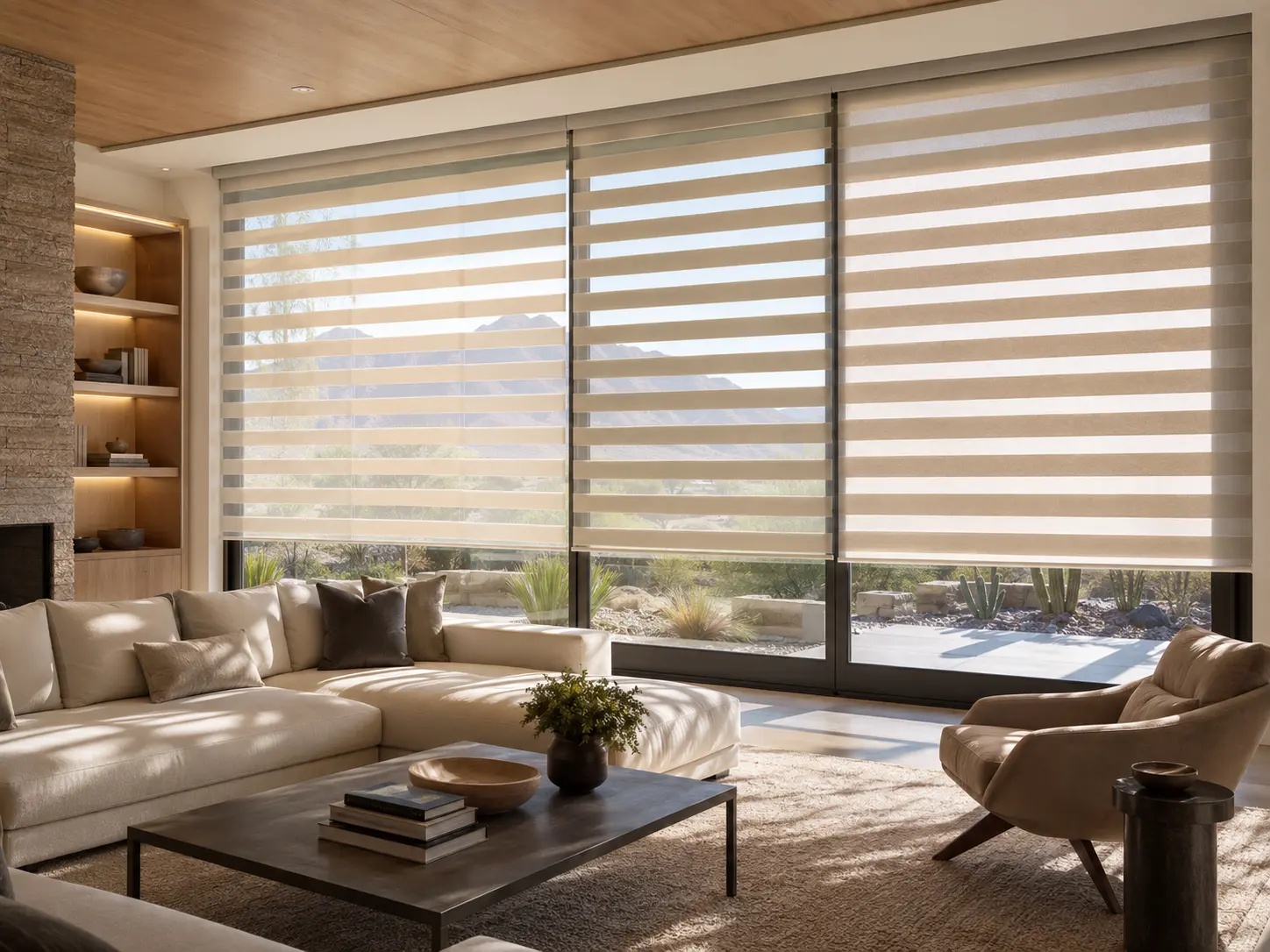 Preliminary inspiration · final product confirmed in your home
Our point of view
Motorized Sheer & Zebra Shades should solve the room—not merely add a motor.
Sheer and zebra shades are useful when a plain roller feels too quiet but a Roman shade feels too decorative. Their layered construction changes as the fabric moves: bands or vanes can align for filtered views, overlap for greater privacy, or lift more fully. The effect is beautiful, but fabric density, nighttime visibility, stack, and hardware must be evaluated in the actual room.
Why consider sheer and zebra shades
What this direction can bring to the home.
Light that can change
Adjust the relationship between sheer and opaque material instead of choosing only fully raised or fully lowered.
A layered modern look
Horizontal bands or floating vanes add dimension while keeping the window treatment visually tailored.
Motorized alignment
Powered movement can make repeated adjustments and grouped operation feel smoother across a room.
Broad design range
Neutral textures, tonal bands, and softer sheer constructions can support both minimal and furnished interiors.
Two related directions
Zebra bands and layered sheers are not exactly the same.
Zebra or banded shades use alternating horizontal strips that overlap as the fabric travels. Layered sheer shades may suspend soft fabric vanes between sheer facings. They create related visual effects, but their movement, privacy, stack, and available motor systems differ.
Privacy is conditional
Daytime filtering does not guarantee nighttime privacy.
Exterior light, interior lighting, fabric openness, band position, color, and mounting gaps all affect what can be seen. Your designer should demonstrate the material against the real exposure rather than relying on a fabric name.
Precision matters
The finished result depends on alignment and proportion.
Band scale, window height, adjacent shade alignment, cassette choice, and how fully the product clears the glass all influence the architecture. Wide or repeated windows deserve careful layout and measurement.
Room-by-room thinking
Where sheer and zebra shades may make the most sense.
These are starting points. Window conditions, fabric, exposure, power, and daily use still determine the final direction.
Living rooms
Balance daylight, view, and a more finished layered appearance.
Home offices
Adjust glare and privacy as screen use and daylight change.
Dining spaces
Bring a soft graphic rhythm to windows without heavy drapery.
Street-facing rooms
Explore flexible privacy while keeping filtered daylight available.
Before you choose
Design the ownership experience too.
Ask how the shades are powered, controlled, recharged or serviced; what happens if a motor or control stops responding; and who supports the system after installation. Exact answers belong to the selected product—not a generic promise.
Explore easy-recharging considerations →A useful comparison
Want natural texture instead of a graphic layer?
Woven shades replace the alternating-band effect with visible fiber and organic variation. They are warmer and less precise by design.
Compare natural woven shades →Straight answers
Questions about sheer and zebra shades.
What is the difference between a zebra shade and a sheer shade?
A zebra or banded shade typically overlaps alternating sheer and opaque horizontal strips. A layered sheer shade may use soft fabric vanes between sheer facings. Exact construction and movement vary by product.
Can sheer or zebra shades provide privacy at night?
They can increase privacy when their opaque portions overlap, but fabric, gaps, interior lighting, and the specific construction affect the result. Nighttime privacy should be reviewed with the real sample.
Can these shades be controlled by remote or app?
Compatible systems may support remotes, grouped control, apps, schedules, or integrations. Availability depends on the exact shade, motor, size, and control platform.
See the difference at your windows
Compare real materials, controls, and movement in your home.
Your designer brings relevant samples, reviews the rooms, confirms the technical details, and provides the exact plan and price.